Monday, February 10, 2025

Suy Niệm Tin Mừng Thứ Tư Tuần thứ 5 Thường Niên.

Suy Niệm Tin Mừng Thứ Tư Tuần thứ 5 Thường Niên. (Gen 3:1-8; Mark 7:14-23)

       Qua bài Tin Mừng, Người Pharisêu và những người Do thái đã chất vấn Chúa Giêsu rất nhiều điều, nhưng với ý tưởng xấu xa của họ, Họ không phải hỏi Chúa Giêsu để tìm hiều hay học hỏi thêm về Chân Lý và sự thật, nhưng mục đích của họ muốn nêu lên những câu hỏi là muốn gài bẫy Chúa Giêsu và để họ có dịp triệt hạ Ngài.. Những người Do thái bình thường thì họ đánh giá cao sự khôn ngoan và sự tốt lành của Chúa Giêsu, trong khi đó, các nhà lãnh đạo tôn giào của họ đã khóa kín cửa lòng của họ, để đánh mất cái khôn ngoan mà không biết sự khiêm tốn và nhân nhượng vì thế họ không thể nhận ra rằng Chúa Giêsu, người  đứng trước mặt họ là người có sự khôn ngoan còn to lớn hơn của vua Solomon.
            Các môn đệ của Giêsu thông thường cũng không thể hiểu được những lời Giáo Huấn của Chúa, nhưng ít ra họ đã có cố gắng tìm tòi và học hỏi them ở nơi Chúa Giêsu. Quan trọng hơn, là họ còn nhớ được những giáo huấn mà Chúa đã truyền dạy cho họ, vì họ hiểu được rằng, sau khi Chúa Giêsu sống lại và lên trời, họ phải có khả năng nhớ lại những điểm quan trọng nhất của giáo lý của Ngài.
            Trong khi Giáo Hội đang được lan rộng trên tất cả trái đất, Dưới sự hướng dẫn khôn ngoan của Chúa Thánh Thần, Giáo hội đã dựa vào những lời giáo huấn của Chúa Giêsu để giúp chúng ta có thể đối phó với rất nhiều câu hỏi đã phát sinh qua các thời đại cũng như đang thách thức trong đức tin và cuôc sống ân sũng thực sự của chúng ta,  Phúc đức, may mắn thay cho chúng ta, những  người đang được hưởng những ân sủng của đức tin, Vì Chúa Giêsu sẽ ban cho  chúng ta Chân Lý và sự thật của Ngài và nhờ đó sẽ giải phóng chúng ta ra khỏi vùng tội lỗi và bóng tối của sự chết.
.
Wednesday 5th Week in Ordinary Time
            The Pharisees and others questioned Jesus but, with a few exceptions, their intention was not to seek the truth but only to trap him. Ordinary people often appreciated the wisdom and the goodness of Jesus while their leaders were locked in their intransigence and could not realize that Jesus stood before them with wisdom greater than that of Solomon. Jesus’ own disciples were frequently unable to understand him, but at least they sought further clarification. More importantly, they remembered better than they understood so that, after Jesus’ Ascension into heaven, they were able to recall the most significant points of his teaching.
            As the Church spread all over the earth, She was able, under the guidance of the Holy Spirit, to rely on that teaching to deal with the many questions which arose throughout the ages to challenge our faith and our way of living.  Blessed are we indeed, who enjoy the gift of faith, the truth given to us by Jesus which sets us free.  Lord Jesus, we thank You for the gift of our faith and ask that we may always be attentive to the enlightenment of the Holy Spirit, who guides us to remember Your teaching with understanding.
 
Wednesday 5th Ordinary Time
Wednesday of the Fifth Week in Ordinary Time
Jesus summoned the crowd again and said to them, “Hear me, all of you, and understand. Nothing that enters one from outside can defile that person; but the things that come out from within are what defile.” Mark 7:14–15
What is within you? What is in your heart? Today’s Gospel concludes with a list of vices that sadly come from within: “evil thoughts, unchastity, theft, murder, adultery, greed, malice, deceit, licentiousness, envy, blasphemy, arrogance, folly.” Of course, none of these vices are desirable when looked at objectively. They are all quite repulsive. And yet too often they are sins that people deal with on a regular basis to one extent or another.
Take greed, for example. When understood clearly, no one wants to be known as one who is greedy. It’s a shameful attribute to have. But when greed is not looked at as greed, it’s easy to fall into the trap of living it. One who is greedy desires an excessive amount of this or that. More money, a better house, a nicer car, more luxurious vacations, etc. Thus, when a person is acting in a greedy way, greed does not seem undesirable. It’s only when greed is looked at in an objective way that it is understood for what it is.
In this Gospel, by naming this long list of vices, Jesus does us an incredible act of mercy. He rattles us and calls us to step back and look at sin for what it is. Jesus also makes it clear that when you live one or more of these vices, you become defiled. You become greedy, a liar, cruel, a gossip, hateful, arrogant, etc. Objectively speaking, no one wants this.
What is it in that list of vices that you struggle with the most? What do you see within your own heart? Be honest with yourself before God. Jesus desires that your heart be pure and holy, freed from these and every filth. But unless you are able to look at your own heart with honesty, it will be difficult to reject the sin with which you struggle.
Reflect, today, upon this list of sins identified by our Lord. Consider each one and allow yourself to see each sin for what it truly is. Allow yourself to despise these sins with a holy wrath and then turn your eyes to that sin with which you struggle the most. Know that as you consciously see that sin and reject it, our Lord will begin to strengthen you and purify your heart so that you become freed from that defilement and become, instead, the beautiful child of God you were made to be.
My merciful Lord, help me to see sin for what it is. Help me, especially, to see my own sin—that sin within my own heart that defiles me as Your dear child. As I see my sin, give me the grace I need to reject it and to turn to You with all my heart so that I can become a new creation in Your grace and mercy. Jesus, I trust in You!
 
Wednesday 5th Ordinary Time 2025
Opening Prayer: Lord God, the coming of your Son has overcome all the barriers that separate people. We are able to be united in Christ as brothers and sisters and as your children. I long for the blessing of the eternal life of heaven.
Encountering the Word of God
1. Old Food Laws: Jesus’ teaching in today’s Gospel takes place immediately after the Pharisees from Jerusalem challenged him about observing their traditions. The Law of Moses provided strict dietary rules that had several purposes. First, they were a protection against foods that could be dangerous if not cooked or prepared properly. Second, they had a penitential dimension. The People of Israel had to make a sacrifice not eating certain foods, like shellfish, pork, and certain cuts of beef. Third, the dietary laws protected the People of Israel from contact and table fellowship with the Gentile (pagan) nations. A day was coming when the dietary restrictions, contained in the Law of Moses, would be rescinded. This is because the blessing given first to the children of Israel would be extended to the Gentiles. The cultural and social barrier between Israel and the Gentiles would no longer be necessary.
2. True Defilement and True Righteousness: The conflict with the Pharisees about their traditions takes place between two bread miracles – one for 5,000 in the territory of Israel and one for the 4,000 in Gentile territory. Mark uses this to indicate that a transition will be happening – a transition between the Old Covenant and the New Covenant. The Pharisees sought Old Covenant righteousness by increasing the number of rules and restrictions and adding their traditions to the Law of Moses. They thought that they could be defiled by the food they ate or by their interactions with public sinners or Gentiles. Jesus brought the Old Covenant to fulfillment in the New and taught that true righteousness is primarily a divine gift and not a human achievement. He also taught that true defilement comes not from the food we eat but from within the human heart.
3. The Blessing of Life and the Curse of Death in the Covenant of Creation: In the first creation story, Genesis starts with the big picture and indicates that God’s creation of the world in seven days signifies that God wills to enter into a covenant with creation, making man and woman not simply his creatures, but his sons and daughters (Gray and Cavins, Walking with God, 13). In the second creation story, which we read today, Genesis zooms in on the creation of the first man. God formed man (Hebrew: adam) from the dust of the ground (Hebrews: adamah) and breathed into him the breath of life. On the one hand, man is a living being, like the other animals, but, on the other, unlike the other animals, because he is spiritual. God planted a garden (paradise) in Eden and put the man there to work in the garden and guard or protect it. Among the trees in the garden, two stood out: the tree of life and the tree of knowledge of good and evil. The first tree was an ancient symbol of immortality and divine wisdom (Proverbs 3:18) and its fruit was thought to confer everlasting life (Genesis 3:22). In short, it represented the covenant blessing and the way that leads to divine life. The second tree symbolized the authority to determine what is good and evil. This authority belongs to God alone. In short, the second tree represented the covenant curse of death that Adam would trigger if he sinned by determine for himself what is good and what is evil.
Conversing with Christ: Lord Jesus, the New Adam, bring about your righteousness in me. Fill me with your grace so that I may do good works and imitate your holiness of life.
 
Wednesday 5th Sunday of Ordinary Time
Opening Prayer: Lord, I believe that your heart is open and ready to receive me this morning. I want to please you. Help me to listen closely to your words as I pray. 
Encountering Christ:
Hear and Understand: After his admonition of the Pharisees (yesterday’s reading) Jesus turned and implored the crowd gathered there to “hear and understand” his teaching. We might imagine some urgency in his manner, reflecting his heart’s desire that the crowd not be misled by their rulers. He was saying it's not what we eat, but how we speak and behave that has the power to either glorify the Father or defile us. May we take his words as seriously as his listeners and disciples did, and reflect and repent, if necessary, on any sins of the tongue or defiling behaviors. 
Special Access: The disciples had been chosen by Jesus for close collaboration in the mission. He dedicated most of his time to forming them with special care and attention. They had the unique privilege of being able to ask Jesus for more detailed explanations of his teachings. We too have the ability to share intimate experiences with Christ since, through prayer and the sacraments, we have a special connection to him and can be alone with him. In this moment of solitude with Christ, let us ask him the questions closest to our hearts.
Jesus’ List: Jesus leaves us no wiggle room when he warns us against behaviors that can sully our soul and separate us from the Father. However, by our power of rationalization we humans can still fall prey to these sins, and others besides. Because we love Jesus, we strive to resist these temptations by putting on the armor of Christ. “So stand fast with your loins girded in truth, clothed with righteousness as a breastplate, and your feet shod in readiness for the Gospel of peace. In all circumstances, hold faith as a shield, to quench all the flaming arrows of the evil one. And take the helmet of salvation and the sword of the Spirit, which is the word of God” (Ephesians 6:14-17). To strengthen ourselves, we frequent the sacrament of Reconciliation, receive the Eucharist at Mass as often as possible, and spend time in prayer each day. 
Conversing with Christ: Lord Jesus, how I want to have a heart like yours! A heart with one desire: to do the will of your Father, to glorify Him, and to love all of humanity! Your heart is the purest of all hearts. My heart is wayward, and I can see by the way I act, by what comes out of my mouth, that I need your grace. Today I choose to let you transform my heart. 
Resolution: Lord, today by your grace I will pay close attention to what I say and strive to glorify you with every word.
 
REFLECTION
"Who knows what evil lurks in the hearts of men?" So goes that famous line from the comic book character The Shadow and how apt a summary for today's Gospel passage. The Pharisees emphasized much on rituals and rules more than they taught principle and meaning of what those rituals and rules meant. They and the people they preached to were so caught up with these rituals and rules that they neglected the spiritual sustenance of
their own souls.
We can go to Mass and pray the same prayers everyday but Jesus reminds us that we should not depend on the Mass and the prayers we recite to cure us from sin or should we recite them to make us become holier, righteous people. The real us depends on what we think and what we really value. It is from our hearts that we achieve who we really are and how we influence those around us. In the first reading we read how the Queen of Sheba was so impressed by Solomon's wisdom that she praised him and gave him expensive presents. However the story ends with the queen returning to her own country without really saying how she applied what she has
learned. Let us ask ourselves today, how do we apply to action what we hear from the mass and from the prayers we recite? Do we reflect and seek the message and true meaning of Jesus' words? Do we pray to our Blessed Mother not because it is our habit to pray the Rosary or because we ask for her intercession but because we want to feel her presence and the love of her Son within us?
Finally, let us be reminded not to allow evil to lurk in our hearts but rather to allow the goodness and purity of God's love to grow within us.

Suy Niệm Tin Mừng Thứ Ba Tuần thứ 5 Thường Niên

Suy Niệm Tin Mừng Thứ Ba Tuần thứ 5 Thường Niên. (Mark 7:1-13 )
Tin Mừng hôm nay là một bản cáo trạng mà Chúa Giêsu lên án các quy luật của con người và những luật lệ mà những người Biệt Phái đã áp đặt nặng nề trên dân chúng. Những luật lệ này không có dính dáng gì tới trong việc thờ phượng Thiên Chúa đích thực.
Trọng tâm của Lề  Luật mà Chúa dạy là yêu mến Thiên Chúa và thương yêu tha nhân. Tình yêu của Thiên Chúa không thể là sự mâu thuẫn với tình yêu tha nhân. Ví dụ, chúng ta không thể yêu mến Thiên Chúa và coi thường  những người khác và bất kính với cha mẹ của chúng ta. Chúa Giêsu là gương sáng  cho mọi người chúng ta bắt chước trong việc thờ phượng Thiên Chúa đích thực của Ngài.
Trong Tin Mừng hôm nay, Ngài bác bỏ việc thực hành những nghi thức rửa tay vô ích trươc khi ăn của những người Biệt Phái, Nhưng Ngài thực sự hiểu biết những gì là cần thiết để trở thành một Người Do Thái đạo đức và những gì là luật lệ vô nghĩa hoặc vô dụng. Đối với những người yêu qúy bản thân mình hơn cả Thiên Chúa, Ngài sẽ không ngần ngại khiển trách để giúp họ nhìn thấy con đường chân chính của sự thánh thiện.
Sự thánh thiện không phải là một sự tuân giữ  luật lệ thế gian một cách hoàn hảo. nhưng phải biết kính mến Thiên Chúa với một trái tim tinh khiết. Ngoài ra , những vị  thánh là những người biết tìm cách sống trong một cuộc sống thật đơn giản, biết sẵn lòng làm những điều tốt cho người khác và giúp đỡ những người nghèo khổ và  bị áp bức.
            Chúng ta không nên bắt chước cuộc sống của những người Biệt Phái. Nhưng thay vào đó chúng ta hãy như vua Solomon trong bài đọc thứ nhất, là người chỉ mong muốn xây dựng được một ngôi nhà cho Thiên Chúa ngự trị, Chúng ta hãy cũng bắt chước xây một ngôi nhà cho Thiên Chúa ngay trong tâm hồn của chúng ta, trong gia đình và trong khu phố của chúng ta. Chúng ta phải biết theo định hướng của Thiên Chúa vì đó sẽ là kim chỉ nam dẫn đưa chúng ta tới không những chỉ là sự thịnh vượng mà còn đưa chúng ta tới sự an bình và hòa hợp trong cuộc sống của chúng ta và trong những gia đình của chúng ta nữa.
 
Reflection:
The gospel is a very strong indictment of the human rules and regulations the Pharisees added to the Torah which deviated from the true spirit of worshipping God. These rules have no place in the genuine worship of God. The heart of the Law is to love God above all things and to love one's neighbor. Love of God cannot be contradictory to love of neighbor. For example, we cannot love God and despise or neglect our parents. Jesus is the best example of true worship of God. In the gospel, he would not perform the useless ritual washings of the Pharisees. He knew what was essential to being a good Jew and what rules were meaningless or useless. Also, he showed his love for his mother to the end. But he clearly put love of his heavenly Father above all things and this he taught to everyone. To people who love themselves more than God, he would reprimand in order to help them see the true path of holiness. Holiness is not in being a perfect accomplisher of rules and regulations but in loving God with a pure heart. Also, the holy man seeks to live a simple life, doing good to his neighbor and helping the poor and the downtrodden. Let us not be like the Pharisees. Instead let us be like King Solomon in the first reading who desired only to build a house for Yahweh to dwell in. Let us also build a house for God in our hearts, in our families and in our neighborhood. We have to be God-oriented because that will bring us not only prosperity but also peace and harmony in our lives and in the lives of our families.
 
Tuesday 5th Sunday of Ordinary Time
Tuesday of the Fifth Week in Ordinary Time
When the Pharisees with some scribes who had come from Jerusalem gathered around Jesus, they observed that some of his disciples ate their meals with unclean, that is, unwashed, hands. Mark 7:1–2
It seems quite clear that Jesus’ instant fame led these religious leaders to jealousy and envy, and they wanted to find fault with Him. As a result, they carefully observed Jesus and His disciples, and they noticed that Jesus’ disciples were not following the traditions of the elders. So the leaders began questioning Jesus about this fact. Jesus’ response was one of severe criticism of them. He quoted Isaiah the prophet who said, “This people honors me with their lips, but their hearts are far from me; in vain do they worship me, teaching as doctrines human precepts.”
Jesus strongly criticized them because their hearts were lacking true worship. The various traditions of the elders were not necessarily bad, such as the careful ceremonial washing of one’s hands before eating. But these traditions were empty if they were not motivated by a deep faith and love of God. The external following of human traditions was not truly an act of divine worship, and that’s what Jesus wanted for them. He wanted their hearts to be set ablaze with a love of God and with true divine worship.
What our Lord wants of each one of us is worship. Pure, heartfelt, sincere worship. He wants us to love God with a deep interior devotion. He wants us to pray, to listen to Him, and to serve His holy will with all the powers of our soul. And this is only possible when we engage in authentic worship.
As Catholics, our life of prayer and worship is grounded in the holy Liturgy. The Liturgy incorporates many traditions and practices that reflect our faith and become a vehicle of the grace of God. And though the Liturgy itself is far different from the mere “tradition of the elders” that Jesus was criticizing, it’s useful to remind ourselves that the many Liturgies of our Church must move from the external actions to interior worship. Going through the motions alone is pointless. We must allow God to act on us and within us as we engage in the external celebration of the Sacraments.
Reflect, today, upon the burning desire in the heart of our Lord to draw you into worship. Reflect upon how well you allow yourself to be drawn into this worship every time you attend the holy Mass. Seek to make your participation not only an exterior one but, first and foremost, an interior one. Doing so will help ensure that the rebuke of our Lord upon the scribes and Pharisees does not also fall upon you.
My divine Lord, You and You alone are worthy of all worship, adoration and praise. You and You alone deserve the worship I offer You from the depths of my heart. Help me and Your entire Church to always interiorize our exterior acts of worship so as to give You the glory that is due Your holy name. Jesus, I trust in You.
 
Tuesday 5th Sunday of Ordinary Time 2015
Opening Prayer: Lord God, I pray that I do not nullify your word by choosing what is merely human and temporal over what is truly divine and eternal. Fill me with your grace so that I may do your will and follow your commandments, especially the commandment of love.
Encountering the Word of God
1. The Pharisees and Their Traditions: In the Gospel, we see that the plot of the Pharisees and scribes from Jerusalem against Jesus continues to take shape. They opposed Jesus from the beginning of his ministry and accused him of blasphemy and associating with sinners. They said that Jesus’ mighty works were diabolical and not divine. Here, they accuse Jesus’ disciples of religious laxity. The Pharisees, who advocated strict observance of the Law of Moses and total separation from the Gentiles, saw that Jesus’ disciples did not wash their hands before eating. Here, Mark takes the time to explain the Jewish practice for his Gentile readers. While the Law of Moses did have rules for the priests to wash their hands and feet before offering a sacrifice and eating their share of the sacrifice, there was no obligation for the people to do so before every meal. This obligation was an oral tradition developed by the Pharisees and extended to every Jewish meal to make it a religious act and expression of Jewish identity.
2. Human Traditions vs. Divine Commandments: Jesus’ responds to the question of the Pharisees and scribes about why his disciples do not follow the tradition of the elders by calling them hypocrites and invoking a prophecy from Isaiah 29:13 that applies to them. In its original context, the prophecy reprimanded Jerusalem for consulting its political leaders while rejecting the prophets. “Because their leaders routinely exclude the Lord from foreign policy decisions and rely instead on their own wisdom, their worship of the Lord has become empty and vain. No longer, says Isaiah, will Yahweh tolerate their lip service when their hearts are devoid of living faith. The Pharisees have fallen into the same trap of rejecting God’s wisdom in favor of their own (Matthew 23:23; Colossians 2:20-23). As a result, their venerated traditions are empty and in dangerous competition with God’s will as be revealed in the gospel” (Ignatius Catholic Study Bible: Old and New Testament, 1800).
3. The Creation of God’s Image and Likeness: The First Reading continues the first account of creation in Genesis. On the fifth day of creation, God filled the realm of the sky with birds and winged creatures and that of the sea with fish and sea creatures. On the sixth day of creation, God filled the earth with animals, and, at the pinnacle of the visible creation, God created human beings in his image and likeness. Human beings are blessed by God and commanded to be fruitful and multiply, fill the earth, subdue the earth, and share in God’s dominion over the other creatures that fill the three realms: the fish of the sea, the birds of the air, and the beasts of the earth. Human beings are not given free license to abuse creation and exploit it as tyrants, but are called to harness creation’s potential for good and use their creative abilities to manage the earth’s resources for the building of human civilization. Human beings are empowered to be the stewards of God’s creation, not its owner or master (Ignatius Catholic Study Bible: Old and New Testament, 59). As the created images and likenesses of God, men and women are God’s children, granted royal authority, and endowed with the sanctity of life. The seventh day, which unlike the first six days knows no end, is set aside by God as a holy day of rest. This means that the days of human work are ultimately ordered to worship and eternal communion with God.
Conversing with Christ: Lord Jesus, you are the Image of God, the Word of God, and the Son of God. Help me to reflect God’s holiness each day as an image of God. Inspire me to be a prophet in this world and communicate the Gospel more perfectly. May I be more docile to the Father’s will as a child of God.
 
Tuesday 5th Sunday of Ordinary Time
Opening Prayer: Jesus, may I approach you in prayer with an attitude of sincerity and purity of intention. Help me to overcome any blindness that there may be in me and give me a real openness to change. 
Encountering Christ:
You Hypocrites: Jesus directly accused the men in today’s Gospel of hypocrisy, using Isaiah’s prophecy from the Old Testament to define it: “This people honor me with their lips, but their hearts are far from me; In vain do they worship me, teaching as doctrines human precepts.” Hypocrisy is as much a temptation for us as it was for the men of Isaiah’s time, and for these Pharisees. There are many manifestations of this sin. The Pharisees were self-righteously misjudging the intentions of the disciples. “How seldom we weigh our neighbor in the same balance with ourselves” (Thomas a Kempis). Is this kind of hypocrisy a weakness of ours? 
Their Hearts Are Far from Me: The Pharisees loved their own traditions to a degree that blinded them to truth and hardened their hearts. They were unable to recognize and embrace Jesus in their midst. We too can proclaim our love for Jesus to others while interiorly rejecting one or more of his precepts, especially those that require us to live counter-culturally. To keep our hearts, close to Jesus, we must pray for the virtue of authenticity and frequently examine our attitudes for even the most subtle signs of interior division. May we have the courage and fortitude to be authentic disciples of Christ in all aspects of our life.
You Nullify the Word of God: Jesus accused the Pharisees of nullifying the word of God by favoring and enforcing their traditions over the law. In other places they were accused of tying “up heavy burdens hard to carry and lay them on people’s shoulders, but they will not lift a finger to move them” (Matthew 23:4). This is a stern warning for those of us in positions of spiritual authority over others—pastors, ministry leaders, parents, etc. We can avoid corrupting others’ experience of the word by remaining close to the heart of Jesus. In the exercise of our authority, we beg for humility, seeking only the very best for those under our care, and offering ourselves as a living sacrifice. 
Conversing with Christ: Lord Jesus, you are calling me to a sincere living of my faith! You are calling me to an attitude of humility and self-examination. You are inviting me to have my heart set on you, and living as if my only fear is to be separated from you. May I take your word to heart and make it the driving force in my life.
Resolution: Lord, today by your grace I will examine my conscience for signs of hypocrisy and repent, begging for humility. 
 
Suy Niệm Tin Mừng Thứ Ba Tuần thứ 5 Thường Niên. (Mark 7:1-13)
Tin Mừng hôm nay Chúa Giêsu cho chúng ta thấy rõ lạ trọng tâm của Lề Luật là yêu mến Thiên Chúa và thương yêu tha nhân. Tình yêu của Thiên Chúa không thể là sự mâu thuẫn với tình yêu tha nhân. Ví dụ, chúng ta không thể yêu mến Thiên Chúa và coi thường  những người khác và bất kính với cha mẹ của chúng ta. Chúa Giêsu là gương sáng  cho mọi người chúng ta bắt chước trong việc thờ phượng Thiên Chúa đích thực của Ngài. Trong Tin Mừng hôm nay, Ngài bác bỏ việc thực hành những nghi thức rửa tay vô ích trươc khi ăn của những người Biệt Phái. Nhưng Ngài thực sự hiểu biết những gì là cần thiết để trở thành một Người Do Thái đạo đức và những gì là luật lệ vô nghĩa hoặc vô dụng.
Ngoài ra, Chúa Giêsu cũng đã cho chúng ta thấy được  tình yêu của Ngài đã dành  cho mẹ của Ngài đến cùng. Ngài cũng đã đạt tình yêu của Ngài với Chúa Cha trên trời ở trên tất cả mọi sự và điều này Ngài đã dạy và làm gương rõ rang cho tất cả mọi người chúng ta. Đối với những người yêu qúy bản thân mình hơn cả Thiên Chúa, Ngài sẽ không ngần ngại khiển trách để giúp họ nhìn thấy con đường chân chính của sự thánh thiện. Sự thánh thiện không phải là một sự tuân giữ  luật lệ thế gian một cách hoàn hảo. nhưng phải biết kính mến Thiên Chúa với một trái tim tinh khiết. Ngoài ra , những vị  thánh là những người biết tìm cách sống trong một cuộc sống thật đơn giản, biết sẵn lòng làm những điều tốt cho người khác và giúp đỡ những người nghèo khổ và  bị áp bức.
            Chúng ta không nên bắt chước cuộc sống của những người Biệt Phái. Nhưng thay vào đó chúng ta hãy như vua Solomon trong bài đọc thứ nhất, là người chỉ mong muốn xây dựng được một ngôi nhà cho Thiên Chúa ngự trị, Chúng ta hãy cũng bắt chước xây một ngôi nhà cho Thiên Chúa ngay trong tâm hồn của chúng ta, trong gia đình và trong khu phố của chúng ta. Chúng ta phải biết theo định hướng của Thiên Chúa vì đó sẽ là kim chỉ nam dẫn đưa chúng ta tới không những chỉ là sự thịnh vượng mà còn đưa chúng ta tới sự an bình và hòa hợp trong cuộc sống của chúng ta và trong những gia đình của chúng ta nữa.
 
Reflection:
The gospel is a very strong indictment of the human rules and regulations the Pharisees added to the Torah which deviated from the true spirit of worshipping God. These rules have no place in the genuine worship of God. The heart of the Law is to love God above all things and to love one's neighbor. Love of God cannot be contradictory to love of neighbor. For example, we cannot love God and despise or neglect our parents. Jesus is the best example of true worship of God. In the gospel, he would not perform the useless ritual washings of the Pharisees. He knew what was essential to being a good Jew and what rules were meaningless or useless. Also, he showed his love for his mother to the end. But he clearly put love of his heavenly Father above all things and this he taught to everyone. To people who love themselves more than God, he would reprimand in order to help them see the true path of holiness. Holiness is not in being a perfect accomplisher of rules and regulations but in loving God with a pure heart. Also, the holy man seeks to live a simple life, doing good to his neighbor and helping the poor and the downtrodden. Let us not be like the Pharisees. Instead let us be like King Solomon in the first reading who desired only to build a house for Yahweh to dwell in. Let us also build a house for God in our hearts, in our families and in our neighborhood. We have to be God-oriented because that will bring us not only prosperity but also peace and harmony in our lives and in the lives of our families.
 
REFLECTION
One need not go to Jerusalem, Lourdes or Fatima to find God and discover his presence among us. Solomon realized this when he offered his prayer at the dedication of the Temple he built for God to dwell in: "If the highest heavens cannot contain you, my God," Solomon prayed, "how much less this Temple that I have built."
God is everywhere in his creation, for all things come from God and bear his creative presence. All things are sacred. God is present in the Book of Sacred Scripture; we know this for ultimately he is the author of Scripture. But is he not the author of all the books that men and women publish, of all the music they compose?
All things are sacred. The ground we stand and walk on today is holy ground, the air we breathe is the breath of God, the sunrise and sunset we delight in, he paints. Simple bread and ordinary wine are holy even before they become food and drink for eternity, before they re-create in our midst the Christian Passover. All we touch today and use are hallowed things.
God is not and cannot be limited. We need only set free the senses of our souls to taste and feel and smell and hear and perceive the spiritual reality embedded in the material world in the midst of which we live.
 

Suy Niệm Tin Mừng Thứ Hai Tuần thứ 5 Thường Niên

Suy Niệm Tin Mừng Thứ Hai Tuần thứ 5 Thường Niên (
Mark 6:53-56 )
Trong thời Chúa Giêsu, người ta tin rằng bệnh tật là do sự trừng phạt vì tội lỗi của mình đã phạm. Trong khi chúng ta biết rằng bệnh tật không phải là sự trừng phạt vì tội lỗi, nhưng bệnh tật có thể xảy ra do một số  hậu quả của tội lỗi. Những thí dụ cụ thể như chứng bệnh ung thư hôm nay càng ngày càng thấy phát hiện nhiều, nhất là các nước tân tiến và kỹ nghệ, Mà nguyên chinh gây ra những bệnh này có thể là vì những nhà máy kỹ nghệ vô đạo đức mà sử dụng các thành phần hoá chất độc hại trong các sản phẩm của họ chỉ vì lợi nhuận?  hay là các chất thải từ kỹ nghệ đã gây độc hại cho môi trường mà chúng ta sinh sống.  Không phải là một số không ít đang phải đối phó với những vấn đề tâm lý vì một số loại bệnh tâm thần đã được gây ra bởi những người thân yêu của chính họ?       Tin Mừng hôm nay nhắc nhở chúng ta biết rằng là chúng ta có thể tìm thấy được sự chữa lành trong Chúa Kitô và được đảm bảo với chúng ta rằng "Tất cả những ai chạm vào Chúa thì sẽ được chữa khỏi bệnh tật."  Nhưng việc được chữa cho được lành bệnh sẽ không xảy ra nếu chúng ta không có đức tin. Và đức tin không phải chỉ là việc tin tưởng không mà thôi , nhưng chúng ta còn phải theo Chúa Kitô. Nếu như chúng ta muốn thoát khỏi cái thế giới đau ốm tâm thần này, thì  chúng ta hãy nên yêu thương nhiều hơn và hãy nên biết tha thứ nhiều hơn. Nếu chúng ta muốn thoát khỏi  được cái thế giới đau bệnh này ,  thì ít nhất các doanh nghiệp trong các nhà máy  kỹ nghệ  đừng nên sử dụng các vật liệu hay hoá chất có tính chất độc hại, và thay vào đó hãy  tìm cách để sản xuất ra các sản phẩm mà không có gì  làm hại cho thế giới. Nếu chúng ta muốn thế gìới này không còn bị những cơn lũ lụt tàn phá như những cơn bão trong năm vừa  qua, Thì chính phủ và người dân chúng ta phải biết bảo vệ các khu rừng và môi trường thiên nhiên.
            Chúng ta hãy mang những bệnh tật, đau ốm  của chúng ta tới với Chúa Kitô và cho phép Ngài  hướng dẫn chúng ta biết tìm đến với sự thay đổi, thống hối và biết ăn năn.
 
Reflection:
There are many illnesses and diseases today that were not present before.  New viruses keep coming out and it is not uncommon to be diagnosed with some kind of viral infection that has not even been named by the medical world. We also hear of many kinds of psychological disorders. During Jesus' time, people believed that sickness was a punishment for one's sin. While we know that sickness is not punishment for sin, it may very well be a consequence of sin. For, is it not that we have cancer today because of the unscrupulous businesses that use toxic ingredients in their products just for profit? Is it not that many have to deal with emotional problems because of some kind of pain inflicted by their own loved ones?
The Gospel reminds us that we can find healing in Christ and assures us that "All who touched him were cured." But healing will not happen without faith. And faith is not just about believing, but also about following Christ. If we wish to rid this world of emotional pains, then we should be more loving and more forgiving. If we wish to rid this world of cancer and other diseases, businesses should never use toxic materials, and instead find ways to create products without harming the world.  If we wish never to suffer from another devastating flood like "Ondoy" then we should all work towards preserving the environment.  
Let us bring our sickness to Christ and allow him to lead us to conversion.  
 
Monday 5th Sunday of Ordinary Time 2025
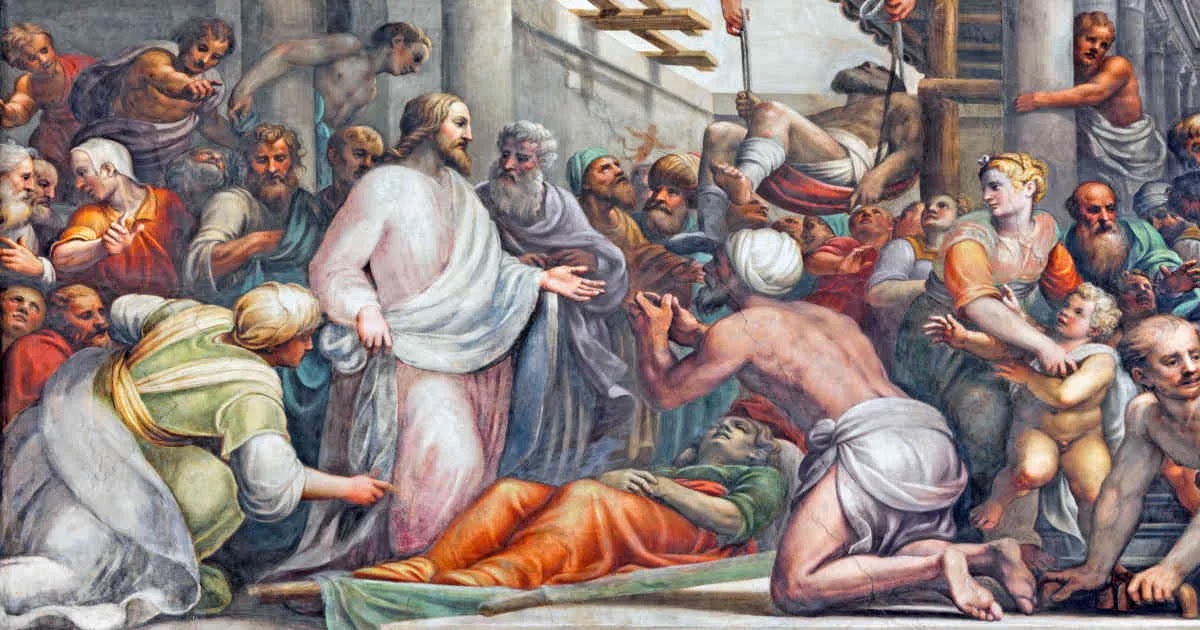
Whatever villages or towns or countryside he entered, they laid the sick in the marketplaces and begged him that they might touch only the tassel on his cloak; and as many as touched it were healed. Mark 6:56
It would have been truly awe-inspiring to witness Jesus healing the sick. The people who witnessed this clearly had never seen anything like it before. For those who were sick, or whose loved ones were sick, each healing would have had a powerful effect upon them and upon their whole family.
Today, modern science, with its ability to treat so many illnesses, has lessened the fear and anxiety over getting sick. But in Jesus’ time, serious illness was of far greater concern. For that reason, the desire of so many people to bring their sick to Jesus so that they could be healed was very strong. This desire drove them to Jesus so that “they might touch only the tassel on his cloak” and be healed. And Jesus didn’t disappoint.
Though Jesus’ physical healings were unquestionably an act of charity given to those who were sick and to their families, they obviously weren’t the most important thing Jesus did. And it’s important for us to remind ourselves of that fact. Jesus’ healings were primarily for the purpose of preparing the people to listen to His Word and to ultimately receive the spiritual healing of the forgiveness of their sins.
In your own life, if you were seriously ill and were given the option to receive either a physical healing or to receive the spiritual healing of the forgiveness of your sins, which would you choose? Clearly, the spiritual healing of the forgiveness of your sins is of infinitely greater value. It will affect your soul for all eternity. The truth is that this far greater healing is available to us all, especially in the Sacrament of Reconciliation. In that Sacrament, we are invited to “touch the tassel on his cloak,” so to speak, and be spiritually healed. For that reason, we should have a much deeper desire to seek out Jesus in the confessional than the people of Jesus’ day had for physical healing. And yet, too often we ignore the priceless gift of God’s mercy and healing offered so freely to us.
Reflect, today, upon the desire in the hearts of the people in this Gospel story. Think, especially, about those who were seriously ill and about their burning desire to come to Jesus for healing. Compare that desire in their hearts to the desire, or lack of desire, in your heart to run to our Lord for the spiritual healings your soul so desperately needs. Seek to foster a greater desire for this healing, especially as it comes to you through the Sacrament of Reconciliation.
My healing Lord, I thank You for the spiritual healing You continually offer me, especially through the Sacrament of Reconciliation. I thank You for the forgiveness of my sins on account of You suffering on the Cross. Fill my heart with a greater desire to come to You so as to receive the greatest gift I could ever receive: the forgiveness of my sins. Jesus, I trust in You.
 
Monday 5th Sunday of Ordinary Time 2025
Opening Prayer: Lord God, Creator of all things, send forth your Spirit and renew the face of the earth. Help me to recognize my need so that I may reach out to you and your Son to be healed. I want to center my life and work totally on you and serve my brothers and sisters as best as I can.
Encountering the Word of God
1. People Immediately Recognized Him: Much of the Gospel of Mark takes place in the villages and towns around the Sea of Galilee. Jesus has just demonstrated his divine power to his disciples by feeding the five thousand (Mark 6:34-44) and by walking on the water as his disciples struggled during the night to go toward Bethsaida. From John’s Gospel we know that the disciples were specifically going to Capernaum (John 6:16), which was about six miles west of Bethsaida. It is curious that Jesus doesn’t bring his disciples to Capernaum, but rather lands them safely at Gennesaret, a village three miles south of Capernaum. By avoiding Capernaum, Jesus was likely avoiding the crowds who wanted to take him by force and make him king (John 6:15). In Gennesaret, the people immediately recognize Jesus and, instead of trying to make him king, bring the sick among them to be healed by him.
2. The Tassel on His Cloak: Earlier, the woman with a hemorrhage was healed by touching Jesus’ garment. It was her faith in Jesus that made her well. Here, Mark speaks about people touching the blue tassels or fringes that Jesus wore on the four corners of his cloak. These tassels were commanded in the Law of Moses and were a reminder to keep God’s commandments and be holy (Numbers 15:37-40; Deuteronomy 22:12). By wearing the tassels, “Jesus is the model of faithfulness to the covenant, who perfectly fulfills the Father’s commands. All who touched [the tassel on Jesus’ garments] were healed – not because of any magical power in the tassel itself, but because of their faith in him who wore it. Here, as often in Mark’s healing narratives (Mark 5:23, 34; 10:52), physical healing is an anticipatory sign of salvation in the full sense, since the same verb, sozo, can be translated ‘heal’ or ‘save’” (Healy, The Gospel of Mark, 133).
3. The Purpose of Creation: For the next two weeks, the First Reading will be taken from Genesis 1-11. The opening chapter of Genesis does not attempt a scientific explanation of how the universe developed but is a revelation about the truth and purpose of creation. The seven days of creation indicate that the universe is a temple fashioned by God. Just as a temple is a sacred place where God can be worshipped, the entire universe is a place where human beings can enter into communion with God the Creator and worship him. The opening lines of Genesis indicate that the earth that God created was, for a time, formless (tohu) and empty (bohu). The first three days of creation provide the structural form, realms, and order to the world. The second set of three days fill the realms created on the first three days. On the first day, the form or realm of time was created with the separation of light (day) from darkness (night). And on the fourth day, the two realms of day and night were filled with their rulers: the sun to rule the day; the moon and stars to rule the night. On the second day, the realm of space was created. And on the fifth day, the two realms of the sky and sea were filled with their rulers: the birds to rule the sky and the fish and sea creatures to rule the waters. On the third day, the realm of the earth (matter, so to speak) was created. And on the sixth day, the realm of earth was filled with its rulers: animals and, above the all the other animals, human beings.
Conversing with Christ: Lord Jesus, you are all holy, faithful, and merciful. You are the eternal Word through whom God the Father created the world. You have recreated the world through your passion, death, and resurrection. Pour out your Spirit within me to sanctify and bring to perfection what you have recreated.
 
Monday 5th Sunday of Ordinary Time
Opening Prayer: Lord Jesus, I begin my prayer today recognizing that through prayer you enter into my life. I spend my life scurrying in many ways and I want to be calm before you, but at the same time I long to bring before you all that is “sick” in me so that you can heal me spiritually, psychologically, and in my relationships. Bless me as I pray.
Encountering Christ:
They Immediately Recognized Him: The people in this Gospel had heard about Jesus, and in great expectation they hoped to see him again to ask him for help and healing. When the disciples got off the boat, the way the Twelve deferred to Jesus confirmed to the onlookers that Jesus, the miracle worker, the Messiah, had indeed arrived. This same Jesus is present in our local church, hidden in the tabernacle. How aware are we of his presence? Do we recognize him there? Do we reverently genuflect and make the sign of the cross as a deferential greeting? Even now, reading and praying, are we fully aware of Jesus, before us, beside us, within us? When our hearts are full of expectation, we are more likely to recognize the presence of Our Lord. 
To Touch the Tassel on His Cloak: In the Gospel stories, the most dramatic healings were often accomplished by the smallest, seemingly insignificant actions, such as touching the tassel of Jesus’ cloak. All that was required by the recipient was an act of faith (see also Matthew 9:20). Jesus asks us to have faith in him. “What great faith our Lord Jesus Christ asks of us—and how just that is. Do we not owe him such faith? It looks impossible to us, but Jesus is Master of the impossible” (Blessed Charles de Foucauld). Do we believe that Jesus can work miracles in our life just because we ask him to?
Great Intercessors: The people of the towns scrambled to bring their sick to the marketplace so that Jesus could heal them. Not only did they carry their ill family members or friends to the town center, (which was probably logistically difficult) but they begged out loud, calling on Jesus to work a miracle. In short, they made spectacles of themselves for the love of those whom they brought with them. We aren’t often called to publicly proclaim our faith in the marketplace but, as Christians, we are to be no less zealous in seeking the spiritual, psychological, or physical healing of those who ask for our prayers. Our Lord is pleased when we intercede for others, and even beg for their salvation. “There is only one thing to do during the brief day, or rather, night of this life: Love Jesus with all the strength of your heart and save souls for him, so that he may be loved!” (St. Thérèse of Lisieux).
Conversing with Christ: Lord Jesus, I desire to recognize you in my life today, to see you before me, beside me, behind me. Help me to be touched and healed by your presence. Infuse me with great zeal for souls so that I may not miss a single opportunity to bring someone closer to you.
Resolution: Lord, today by your grace I will make a conscious effort to look for your presence in my day and, strengthened by you, reach out to someone on your behalf.